
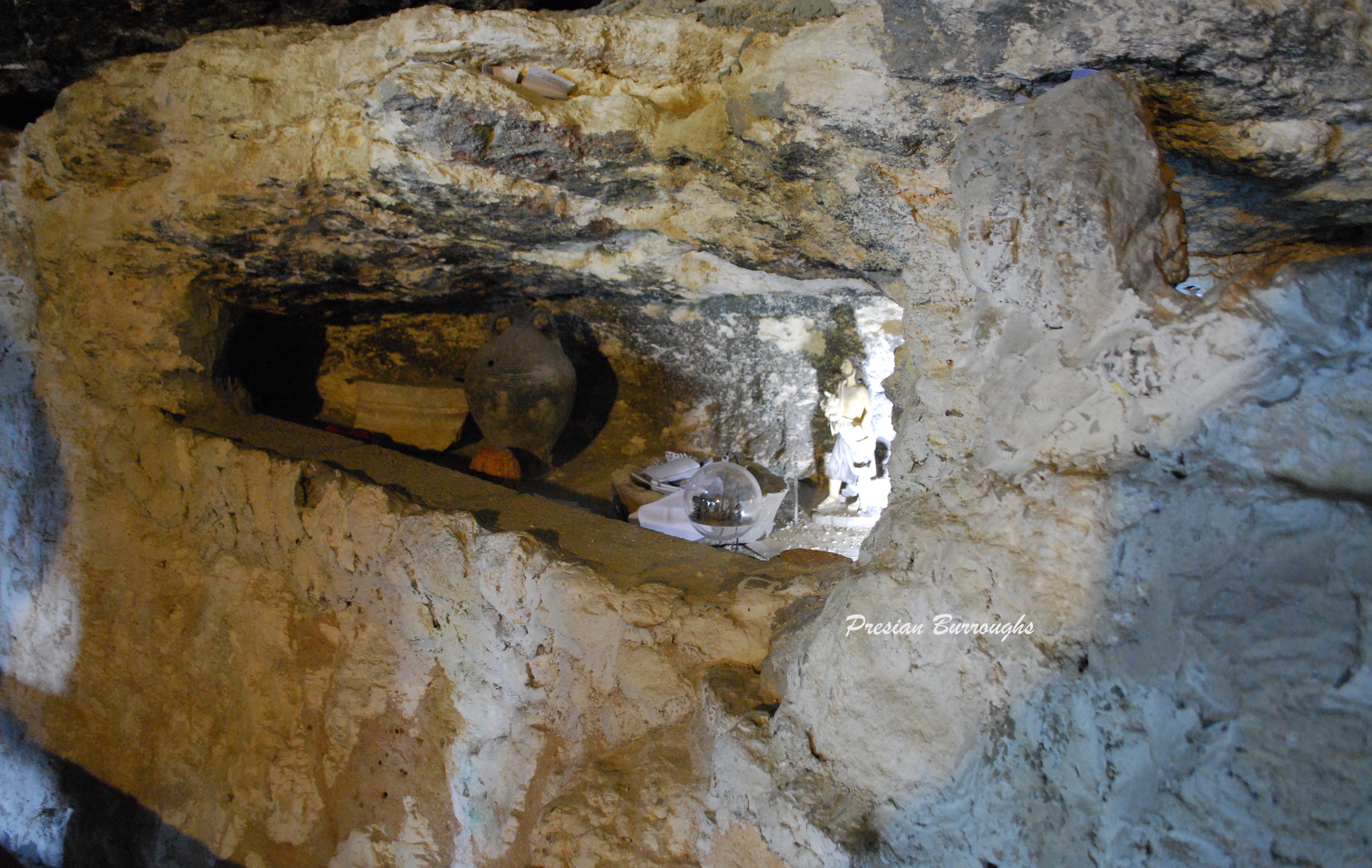
“And [Mary] gave birth to her firstborn son and wrapped him in bands of cloth, and laid him in a manger, because there was no place for them in the inn” (Luke 2:7).
Christmas nativity scenes often portray Jesus lying in a wooden feeding trough.

However, it is much more likely that the manger was stone; it was the earth itself.
The hills of Judea contain lots of limestone (calcium carbonate).[1] Natural caves developed in the soft, chalk earth. Sometimes the ancient peoples living in that region would also create caves for shelter and burials. The underground caves provided vital shelter from the cold winds rushing over the hills and through the valleys of Judea during winter months. They provided shade and coolness in hot summer months. The caves allowed people to contain and protect their livestock, especially at night. Along the walls of the stable-cave were troughs for feeding the animals.

It’s very likely that Mary gave birth to Jesus in a cave that also functioned as a stable. She would have laid him in a stone trough, a nook in the earthen walls, like the one shown here.
On Christmas morning, the calcium carbonate bones of the earth cradled Jesus’ newborn body.
And after Jesus died from crucifixion, the earth again cradled his spent body.
“Then [Joseph] took [Jesus’ body] down, wrapped it in a linen cloth, and laid it in a rock-hewn tomb where no one had ever been laid” (Luke 24:53).

The earth in these passages of the Gospel story plays a foundational role in cradling Jesus’ divine-human body. Truly, the earth honorably functioned as the Lord’s footstool throughout his days. “Thus says the Lord: Heaven is my throne and the earth is my footstool; what is the house that you would build for me, and what is my resting place?” (Isaiah 66:1). The earth itself created a magnificent sanctuary for our Lord, a sanctuary functioning both as a place of worship and a place of refuge.
How does the firm earth cradle your body? Do you receive its embrace? Do you acknowledge the ways in which the earth provides stability and the sources of sustenance for your body to function? How might you draw closer to your Creator God in the midst of the earthly sanctuary and delight in God’s dwelling with us here on earth?
Please join my list of friends!
Get new content delivered directly to your inbox.
[1] Nurit Shtober-Zisu and Boaz Zissu, “Lithology and the Distribution of Early Roman-Era Tombs in Jerusalem’s Necropolis,” Progress in Physical Geography 42, no. 5 (2018).
Leave a Reply