Alleviating the Problems of Plowing, Solution 1: No-Till Agriculture

Plowing causes serious problems in our ecosystems. Erosion (loss of soil itself) and soil degradation (loss of nutrients and soil compaction) are two significant problems that affect localized fields and areas downstream. But plowing also releases large amounts of greenhouse gases into the atmosphere; this is a global challenge. Now more than ever before, people recognize these disadvantages. Yet farmers continue to plow (as we humans have done for millennia). That’s because plowing does some important work in the agricultural process.

Plowing provides two primary advantages to farmers. 1) It upends plants (often called weeds) that would otherwise interfere with the growth of the new crop. 2) Plowing also opens the moist, nutrient rich soil where seeds can germinate.

Image from https://iowaagliteracy.wordpress.com/2015/04/27/why-do-they-do-that-plowing-or-tilling-fields/.

If farmers want to avoid or alleviate the negative drawbacks to plowing, they must figure out how to simulate its benefits. Farmers need ways to decrease the presence of unwanted plants that compete for nutrients, water, and light, and they need new technologies that help them place the desired seeds or seedlings into the nourishing soil without plowing. These tactical questions have captured the attention of many agronomists and farmers in recent decades.

The advent of agricultural chemicals (such as herbicides) has enabled scientists to develop one set of solutions. With the help of chemicals (such as glyphosate, the primary active ingredient in Roundup®) that kill vulnerable plants, farmers can now spray fields to kill unwanted plants and thereby avoid plowing. The weeds and other unwanted plants in the field die, making way for a new generation of seeds and seedlings to grow. This method of farming is called no-till conventional agriculture or is sometimes named conservation agriculture (because it focuses on conserving the soil).

With the weed problem out of the way, how do farmers open the ground so that new seeds can germinate in the moist soil? In the words of geologist David Montgomery, “No-till farmers . . . use specialized planters that open a narrow slot in the soil about the width of a kernel of corn. Seeds drop down into the slot, disturbing much less of the surrounding soil than plowing it up would.”[1] Along with this seed drill, innovative people have created equipment that “injects a uniform amount of fertilizer adjacent to and below each just-planted seed, putting nutrients right where plants need them—and only there. This uses far less fertilizer than spraying it all over the field. The farmer saves money and fewer chemicals run off to pollute streams, lakes, and oceans. That sounds like a win-win, except of course to fertilizer companies.”[2] This approach to agriculture greatly improves soil structure, reduces soil erosion and the release of greenhouse gases, retains moisture in the soil, and even reduces fertilizer run-off.

Of course, the big drawback to conventional no-till agriculture is its use of herbicides. I’ll present recent scientific findings on the effects of glyphosate on soil microbes and macrobes, insects, amphibians, birds, and mammals in future posts.  

A less deadly no-till method of farming exist. Let’s consider it.

Image from http://clipart-library.com/pictures-of-poison.html.

No-till organic agriculture would appear to some to be doomed for failure since no synthetic agro-chemicals (such as herbicides) are used to kill and control weeds. But innovative farmers have developed new solutions for controlling weeds. In the fall, they plant a cover crop, such as rye or vetch, to out-compete weeds and to add nutrients and organic matter to the soil.

In the spring, farmers use a special roller-crimper that breaks the stems of the cover crop, killing the plants and laying them flat on the ground.[3] Farmers then use a seed drill to plant crop seeds into the soil underneath the layer of plant mulch (left-over from the cover crop; see image) that helps the soil absorb and maintain moisture and discourages the growth of weeds.[4] The organic no-till approach requires farmers to time their rolling-crimping perfectly so that the cover crop plants actually die but also before these plants produce viable seeds (that could then grow as competitors to the crop plants).

Image from https://www.ecofarmingdaily.com/build-soil/tillage/book-week-organic-no-till-farming/.

Both conventional and organic no-till systems enable farmers to implement three “best practices” that support long-term soil health and nutritious food. These practices include “minimum disturbance of the soil;” “growing cover crops and retaining crop residue so that the soil is always covered;” and “use of diverse crop rotations.”[5]

While I applaud the soil-conserving-achievements of conventional no-till farming, I believe scientists have collected enough data on the negative effects of glyphosate and other herbicide ingredients to give us pause. Farmers, consumers, politicians, and even agri-business employees should take a good, hard look at the data and reconsider whether conventional no-till methods—with its dependence on deadly chemicals—should be maintained. We’ll consider the evidence against glyphosate soon!


Please join my list of friends!

Get new content delivered directly to your inbox.


[1] David R. Montgomery, Growing a Revolution: Bringing Our Soil Back to Life (New York: W. W. Norton & Company, 2017), 22.

[2] Ibid.

[3] The Rodale Institute developed the roller-crimper. https://rodaleinstitute.org/why-organic/organic-farming-practices/organic-no-till/

[4] https://www.no-tillfarmer.com/articles/6497-cover-crops-can-make-organic-no-till-work

[5] Montgomery, 68.

The Problems of Plowing, Part 2: Erosion

You’ve probably seen pictures of what can happen after fields are plowed: soil erodes. Winds blow across plowed fields, stirring up and carrying away topsoil. Waters rush across naked soil, sweeping it into streams, roads, and other unintended destinations.

Photo by Fred Farrell on June 3, 2005 in San Luis Valley, Colorado (https://infosys.ars.usda.gov/winderosion/multimedia/2005storms/big/SLVSandStorm6.jpg)

Sometimes erosion happens in the early spring before farmers even get tractors onto the fields. This is because, back in the fall, the crops had been harvested and most of the plant debris removed from the field. Without the protection that mulch and plants with thick roots provide, the soil isn’t sufficiently protected from winter and early spring precipitation and wind.

Photo by Jerry Grigar on April 28, 2004 near Kalamazoo, MI (https://infosys.ars.usda.gov/winderosion/multimedia/2004storms/big/000_0379.jpg)

Erosion also occurs after spring plowing and planting. It takes weeks for seeds to germinate into seedlings and for seedlings to grow into strong plants with significant root systems. Rain or drying winds can easily lift the precious topsoil away from around and even under these plants. Water can even uproot crops and carry them downstream.

Photo by Natural Resources Conservation Service – New Mexico, U.S. Department of Agriculture in 2016 (https://www.nrcs.usda.gov/wps/portal/nrcs/detail/nm/programs/financial/eqip/?cid=nrcseprd323312).

Over the past century America has learned the hard truth of soil erosion. After the Dust Bowl, the American government encouraged farmers to adopt soil conservation techniques, which they’ve done very effectively. However, recent studies have shown that economic pressures may convince farmers to put fragile lands back into crop production. For example, although Dakota farmers had chosen to put some fields out of production and revert them back into grassland in order to conserve soil, the high sale price of corn in the late 2000s and early 2010s (yes, this is when the government strongly supported the expansion of corn-based ethanol for fuel![1]), enticed them to plow up fragile lands and plant nutrient- and water-hungry corn.[2] This has led to serious increases in soil erosion throughout the Dakotas since that time.[3]

Now, let me be clear—the farmers who choose to put more land into crop production are not greedy; most American farmers find it challenging to pay their bills, let alone send their kids to college, with their farming income alone. They aren’t intending to damage the earth, and most farmers aren’t getting rich from their farming labors. When demand and prices are high for a particular crop, they meet the demand. But studies demonstrate that we need new and better policies that take ecosystem and soil health into consideration. We also need better economic incentives that will enable farmers to make a good income and care for their soils on which we, and future generations, depend.[4]

One of the chief reasons we all need to be concerned with conserving our soils is because they’re disappearing and being degraded. In the US since the 1950s, “about one-third of American cropped land has had to be abandoned because of erosion problems.”[5] And when we look at the global problem of erosion, we find that human activity—especially agriculture—over the past 150 years has caused nearly half of earth’s topsoil to be swept away.[6]

This is really bad news. First and foremost, it’s bad news because erosion removes nutrient-rich topsoil. But it also reduces the soil’s ability to absorb water later. Erosion, then, leaves soil more vulnerable to further erosion and decreases the soil’s capacity to support plant life. Erosion is a triple whammy since topsoil takes decades, if not centuries, to develop. On its own, an ecosystem can create one inch of soil in about 300 to 1000 years. This process can be shortened to 30 years if people add organic matter, fungi, and nutrients to thin soils to promote topsoil development.[7] In other words, we can’t just snap our fingers (or spray on some chemicals) and make fertile soil out of thin air. And without good topsoils, we can’t feed ourselves sufficiently. Sure, we can grow a few types of crops by soilless means (such as by hydroponics), but our primary staples—grains, such as rice, wheat, and corn and legumes, such as soy—need soil to grow.[8]

Farmers know the importance of soil health and wring their hands over the loss of this, their most valuable resource. Some farmers even consider themselves to be growing soil more than anything else! They, along with agronomists, have been tackling the problems of plowing—both of erosion and greenhouse gas emissions—in a variety of ways. In future posts, I’ll discuss two types of solutions: one involves adopting low-till and no-till methods and the other involves growing a different type of plant altogether.

Much more could be said about how plowing increases soil erosion and how erosion is deleterious to our food system. If you’re interested in knowing more about the preciousness and vulnerability of soil, I’d recommend two engaging and accessible books by geologist, David Montgomery:

  • Dirt: The Erosion of Civilizations
  • Growing a Revolution: Bringing our Soil Back to Life.

Please join my list of friends!

Get new content delivered directly to your inbox.


[1] See, for example, https://www.ag.ndsu.edu/energy/biofuels/energy-briefs/history-of-ethanol-production-and-policy, which explains that “The Energy Independence and Security Act of 2007 signed by President Bush requires renewable fuel usage to increase to 36 billion gallons annually by 2022” and that up to 15 billion gallons of that total can be from corn.

[2] Tom Wang et al., “Soil Conservation Practice Adoption in the Northern Great Plains: Economic Versus Stewardship Motivations,” Journal of Agricultural and Resource Economics 44, no. 2 (2019).

[3] Benjamin L. Turner et al., “Scientific Case Studies in Land-Use Driven Soil Erosion in the Central United States: Why Soil Potential and Risk Concepts Should Be Included in the Principles of Soil Health,” International Soil and Water Conservation Research 6 (2018).

[4] Turner et al explain, “few economic or policy mechanisms exist to balance contemporary land use trends [such as the increase in transitioning grassland into cropland] with conservation areas or give producers incentives to adopt soil and water conservation practices at the farm level, despite the documented soil health benefits” [ibid., 74.].

[5] Peter Warshall, “Tilth and Technology: The Industrial Redesign of Our Nation’s Soils,” in The Fatal Harvest Reader: The Tragedy of Industrial Agriculture, ed. Andrew Kimbrell (Washington: Island Press, 2002), 173.

[6] World Wildlife Foundation, “Soil Erosion and Degradation,” accessed 25 September 2019. https://www.worldwildlife.org/threats/soil-erosion-and-degradation.

[7] Wes Jackson, New Roots for Agriculture, New ed. (Lincoln: University of Nebraska Press, 1985), 17.

[8] Warshall,  in The Fatal Harvest Reader: The Tragedy of Industrial Agriculture, 170.

The Problems of Plowing, Part 1: Greenhouse Gases

We all know tractors burn fuel and release CO2 into the atmosphere. It is rather obvious, then, that plowing with tractors increases the concentration of greenhouse gases in the atmosphere.

But did you also know that simply opening the soil to air during plowing also releases greenhouse gases? When the organic matter in soil (such as roots, plant debris, and dead organisms) is exposed to oxygen, the processes of decomposition speed up. That means some of the carbon and nitrogen molecules that had been trapped in plant and animal tissues underground gets converted into CO2 and N2O. Those gas molecules then become part of the atmosphere, increasing its concentration of heat-trapping gases.

Scientists estimate that between 1900 and 1950, when American farmers initially converted the Great Plains from native grasslands to croplands,[1] 50% of the soil’s natural carbon stores were released into the atmosphere.[2]

Another estimate figures that “[b]y 1980, roughly a third of the carbon humanity had already added to the atmosphere since the Industrial Revolution came from plowing up the world’s soils, primarily in the Great Plains, Eastern Europe, and China.”[3] We usually only think of factories, vehicles, and fires as adding CO2 to the air. But digging into the earth and uncovering carbon-rich, fertile soil also significantly alters the chemistry of our earth’s atmosphere.

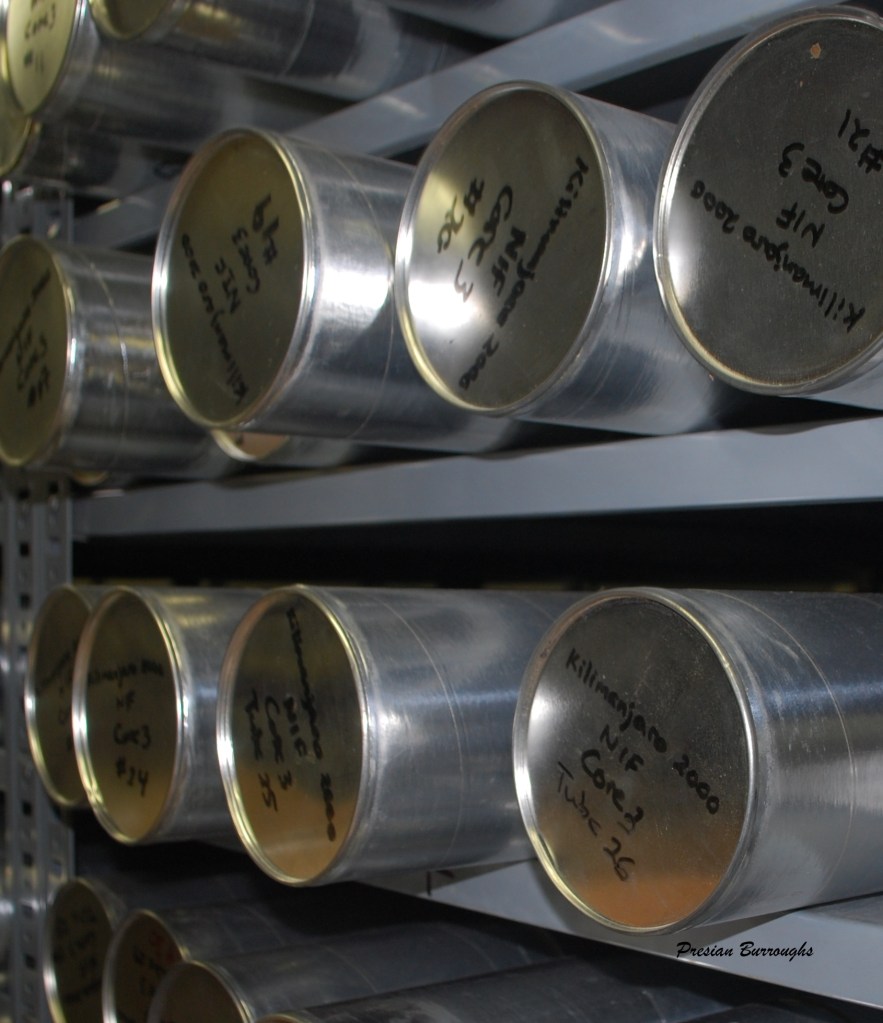
(Image of ice core samples at the Byrd Polar and Climate Research Center; photo by Presian Burroughs)

Not only does plowing cause CO2 to disperse into the air, it also decreases the soil’s fertility. Without sufficient carbon in the soil, microbes and macrobes (think, bacteria and worms) don’t have enough to eat and therefore die. Without the microbes and macrobes living there, minerals in the soil and nitrogen from the atmosphere cannot be converted into the nutrients plants need to absorb. Over the years, the process of plowing actually decreases the fertility of the soil and the earth’s ability to make new topsoil.

In addition to decreasing the amount of carbon in the soil, plowing speeds up the process of mineralization—the process by which nitrogen that once made up the proteins and amino acids of decaying plants and animals is broken down and converted into molecules plants can absorb.[4] Although this feeds plants in the short-term, after a few years, once the initial nitrogen is used up, the soil no longer has the ability to replenish the nitrogen unless nitrogen-fixing legumes are grown there.

Meanwhile, some of the soil’s nitrogen ends up as N2O and dissipates into the atmosphere. Consequently, from 1900 to 1950 when the native grasslands of the Great Plains were being plowed up and made into crop fields, the earth experienced “an increase in soil N2O emissions, translating into a substantial net release of [greenhouse gases]”.[5]

Plowing, then, not only diminishes soil fertility but also increases greenhouse gas concentrations.

(Image of water vapor and other gases rising from plowed field is from https://pixabay.com/photos/fog-mood-landscape-fog-bank-66270/.)

Decreasing soil fertility is a perennial problem farmers face, and scientists have been eager to find solutions. By the early 1900s soil scientists recognized the fundamental importance of nitrogen (in addition to potassium and phosphorus) for plant health and agricultural yield. Simultaneously, the bomb-making war efforts of WWI and WWII gave scientists new technologies that could take unreactive N2O from the atmosphere and convert it into ammonia through an energy-intensive reaction called the Haber-Bosch process. This process provided the means for chemists to create liquid chemical fertilizers that the now degraded soil in America’s heartland needed more than ever. But these fertilizers come at a high energy and ecological cost: making nitrogen fertilizers “consumes more energy than any other aspect of the agricultural process. It takes the energy from burning 2,200 pounds of coal to produce 5.5 pounds of usable nitrogen.”[6] In other words, in our fossil fuel based economy, manufacturing synthetic nitrogen fertilizers necessarily releases large amounts of CO2 into the atmosphere.

But that’s not all. Some of the nitrogen-based fertilizer sprayed on fields ends up as N2O in the atmosphere. Scientists estimate that about 1% of nitrogen fertilizer dissipates into the atmosphere.[7]

While this may not sound like much, the collective global effect of spraying fields with nitrogen fertilizer and spreading organic sources of nitrogen, such as manure, is staggering. Globally, the agricultural sector emits over 7,000,000 tons of N2O each year.[8]

(Image of increasing global N2O concentrations is from https://www.esrl.noaa.gov/gmd/hats/combined/N2O.html.)

A significant problem attending this situation is that nitrous oxide “is about three hundred times more powerful than carbon dioxide in creating climate warming.”[9] Nitrous oxide is a much more effective blanket than CO2.

Along with increasing the earth’s concentration of N2O, nitrogen fertilizers also harm aquatic ecosystems. Scientists figure about half of the nitrogen fertilizer farmers spray on crops isn’t even absorbed by the plants![10] Where does so much of the nitrogen-based chemical go? A bit of it floats into the atmosphere, as indicated above, but a lot of it ends up in our waterways, causing algal blooms and dead zones (I’ll discuss this in a future post). Overall, relying so heavily on chemical nitrogen fertilizers is simply not efficient or sustainable.

Although we might assume plowing is a benign and essential part of growing food, the facts of the matter indicate that plowing isn’t exactly healthy for our ecosystems. Plowing results in:

  • A decrease in the soil’s carbon stores (which leads to degraded soil fertility and structure)
  • An increase in atmospheric CO2 concentrations (from tractor power, soil exposure, and the manufacture of nitrogen fertilizers)
  • A decrease in the soil’s nitrogen stores
  • An increase in atmospheric N2O concentrations (from soil exposure and dissipation of nitrogen-based fertilizers)
  • An increase of nitrogen in waterways and a decline in aquatic biodiversity and vitality
  • A decline in the soil’s biome (the microbes and macrobes that make fertile soil possible)

With all these drawbacks (in addition to another big one: soil erosion), it becomes clear why scientists and farmers work hard to find alternatives to conventional, industrial agricultural methods.

And when I consider these ecological factors in conversation with the Christian scriptures, I find theological reasons for supporting ecologically healthier forms of agriculture. For example, since Genesis 1 indicates that God created the world to be fertile and filled with a diversity of living beings (see my “The Creative Roles of Water  & Land in Genesis 1:1-25”), I am led to question the ways in which industrial forms of agriculture undermine fertility and biodiversity. And since Genesis 1:29-30 explicitly teaches humans to share the plants of the earth with the rest of God’s creatures (see my “A Call to Share Plants & Soil: Genesis 1:29-30”), the destructive effects of plowing on the soil’s biome and global climate stability lead me to think long and hard about how we grow and eat our food.

Whether motivated by theological principles or not, people are beginning to recognize that plowing actually works at cross-purposes with our efforts to grow abundant and healthy food. Consequently, some farmers have turned to no-till and low-till methods of planting crops not only to avoid the problems outlined here but also soil erosion. These methods, however, often (but not always) rely on the use of herbicides and GMO crops. Since these are complex topics in and of themselves, we’ll consider them soon. Stay tuned!


[1] This transition from grassland to crops of course took place after the US unjustly and violently confiscated the lands and livelihoods of the Native Americans who once made their homes in the Great Plains. The foundation upon which American agriculture has been built is bloodstained and a shameful part of US history.

[2] Melannie D. Hartman et al., “Impact of Historical Land-Use Changes on Greenhouse Gas Exchange in the U.S. Great Plains, 1883-2003,” Ecological Applications 21, no. 4 (2011): 1117, http://dx.doi.org/10.2307/23022983.

[3] David R. Montgomery, Growing a Revolution: Bringing Our Soil Back to Life (New York: W. W. Norton & Company, 2017), 57.

[4] David Crohn, “Nitrogen Mineralization and Its Importance in Organic Waste Recycling,” accessed January 4, 2020. https://alfalfa.ucdavis.edu/+symposium/proceedings/2004/04-277.pdf.

[5] Hartman et al.,  1117.

[6] Jason McKenney, “Artificial Fertility: The Environmental Costs of Industrial Fertilizers,” in The Fatal Harvest Reader: The Tragedy of Industrial Agriculture, ed. Andrew Kimbrell (Washington: Island Press, 2002), 127.

[7] Hartman et al.,  1117.

[8] Debra A. Miller, Farming and the Food Supply, Confronting Global Warming (Detroit: Greenhaven Press, 2011), 80-81.

[9] Ibid.

[10] The Intergovernmental Panel on Climate Change calculates that “approximately 50% of the N applied to agricultural land [is] not taken up by the crop” [Gensuo Jia and Elena Shevliakova, “Chapter 2: Land-Climate Interactions,” in Climate Change and Land: An Ipcc Special Report on Climate Change, Desertification, Land Degradation, Sustainable Land Management, Food Security, and Greenhouse Gas Fluxes in Terrestrial Ecosystems (27/04/2019), 5.].