
Four reasons why I read Romans and the Pauline Epistles in their first-century political context

Four reasons why I read Romans and the Pauline Epistles in their first-century political context
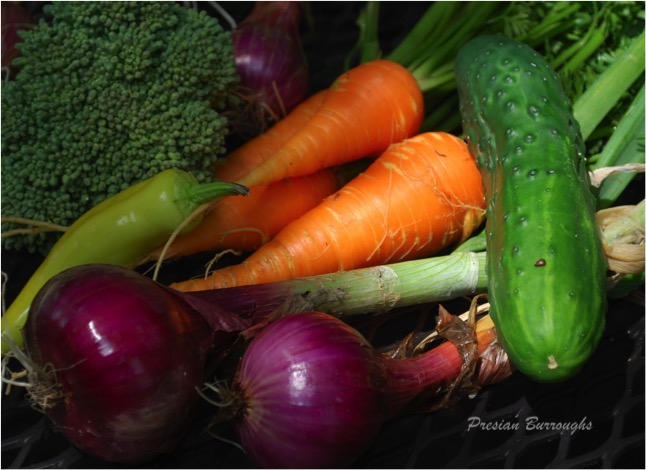

We connect with God, people, other creatures, plants, and non-living things through our eating and drinking. Our food choices, in turn, affect the wellbeing of ecosystems, people, animals, and plants. In light of God’s purpose to liberate creation from its slavery to destruction (Rom 8:21), Christians may reasonably conclude that we follow our Lord’s designs when we minimize creation’s destruction. More specifically, we might extrapolate from Paul’s instructions to the Christians in Rome that we should “not, by [our] eating, destroy that one for whom Christ died” (Rom 14:15b) (Presian’s Translation). Christ’s death liberates human creatures from our slavery to sin and death and nonhuman creation from its slavery to destruction (Rom 5–6; 8:19–21). Such a central theological conviction offers Christians a guiding ethical principle: we are called to live our lives in ways that cause minimal amounts of undue and long-term forms of suffering and degradation to people, animals, plants, and ecosystems. We are invited, instead, to cooperate with God in the divine work of establishing justice and restoring life.
There are countless ways we can decrease destruction and inspire restoration in God’s creation through our food and farming choices. The following set of checklists are provided to congregational leaders and participants to get this dauting process started. Congregations are encouraged to engage in a congregational food audit, in which they strive (over a reasonable period of time) to implement strategic goals related to food production and consumption in their worship spaces and homes.
With the above goals in view, leaders and congregants might evaluate the following aspects of the faith community’s activities to ensure that love for God and love for human and nonhuman neighbors guide its decisions related to food:
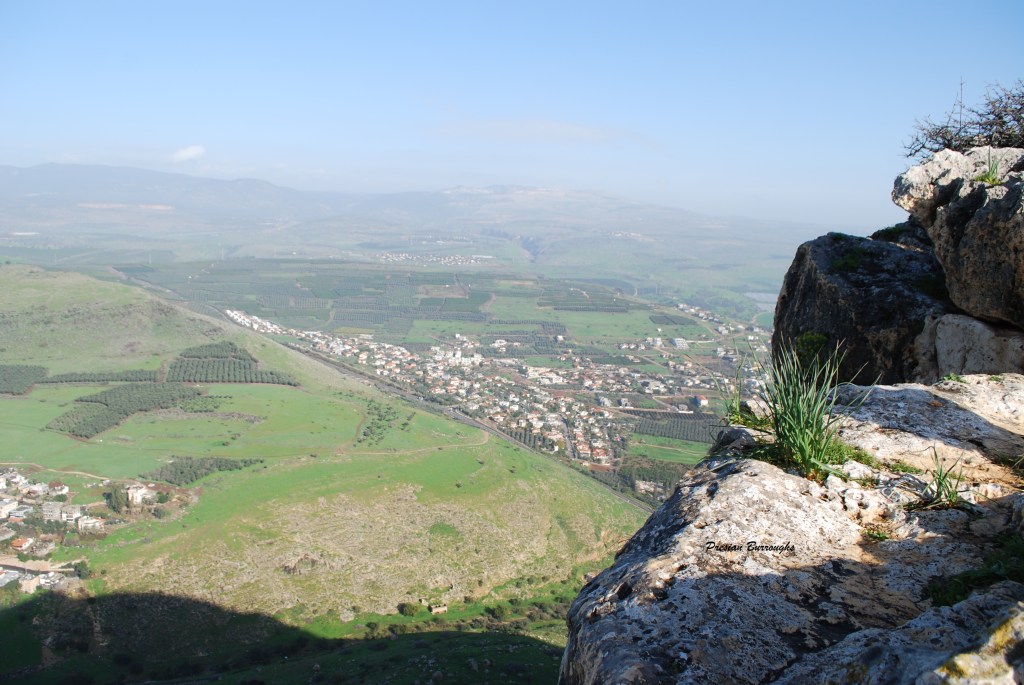
During the first Sunday of Lent, the Revised Common Lectionary directs Christians to read Genesis 3 and Romans 5. These texts can expose the ways in which we are all complicit in acts of destruction, in the undoing of creation.
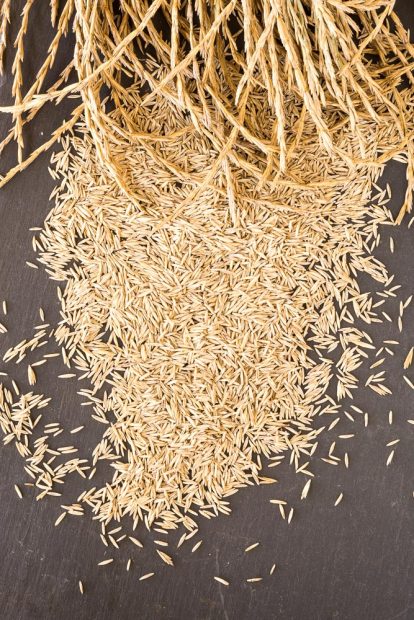

What if farmers didn’t have to plow up the ground every year? And what if they didn’t even have to re-seed their crops every year? Wouldn’t that be amazing and revolutionary?
Grain from the perennial plant, Kernza®. Image of Kernza® perennial grain, developed by plant breeders at The Land Institute. (https://landinstitute.org/our-work/perennial-crops/kernza/). ©️ The Land Institute.
It would indeed. Agriculture would be revolutionized, because humans have depended on annual crops since the birth of agriculture. If farmers didn’t have to sow new seeds each year to grow our primary commodity and staple crops (corn, wheat, soybeans, etc.), the agricultural system would change in significant and positive ways.
Right now our staple crops are annual plants and therefore experience their full life cycle in one growing season. In other words, they fully mature, produce seeds, and then die; those same plants will not grow back the next year. Annual varieties of rice, wheat, oats, corn, soybeans, etc. form the foundation of our diets (in part, because they can be transported and stored without refrigeration for much longer than veggies, fruits, and meats). However, these staple foods require yearly disturbance of the soil for planting. It’s estimated that “annual crops account for roughly 70% of the human population’s food calories and the vast majority of planted croplands worldwide.”[1] (They provide a lot of domesticated animals with their calories too!) Having no other option than to plow and plant our staple crops is a major ecological problem. As we’ve seen in earlier posts on the problems of plowing (parts 1 and 2), our dependence on annual crops—and therefore on plowing and, more recently, on herbicides—results in ecological degradation (and sometimes destruction).
Because of these problems, a growing number of scientists all over the world are trying to develop perennial crops. Perennial plants flower and develop seeds during the summer for several (or many) years in a row. Although their above ground vegetation might die back during winter, their roots remain alive underground and quickly send up new shoots in the spring. The perennial plant then expands during the new growing season and flowers, produces seeds, and goes dormant over the winter.
Perennial plants, such as native prairie grasses, live year after year. They therefore develop strong, deep root systems. Their roots reach much deeper than annual grasses and therefore can access nutrients and water farther underground (see the image to the right comparing annual wheat to perennial wheatgrass). Reaching deeply into the soil is vitally important during droughts. And because these perennial plants have such healthy root systems, they hold precious soils in place when winds blow and waters flow. Additionally, perennial plants do not have to expend precious energy and nutrients to grow whole new root structures each growing season. And because perennials can quickly produce new leaves in the spring, they are more likely than annuals to out-compete any weeds tempted to grow near by.
Recognizing these powerful attributes of perennial plants, plant geneticist Wes Jackson endeavored in the 70s to develop perennial crop varieties. He began The Land Institute in Salina, Kansas to research and develop perennial varieties of wheat, legumes, oilseeds, rice, sorghum, and wheatgrass (which produces grains much like wheat). The Land Institute has made great strides in developing a perennial wheatgrass called Kernza®. Its grains provide “more minerals and more of some vitamins” than traditional wheat flour.[2]
The scientists who have been perfecting Kernza® for wider cultivation have recently given their blessing to its commercialization. A few farmers are growing Kernza®, a few bakers and cooks are incorporating it into their recipes and products, and a few consumers are purchasing Kernza® and its products (where and when available). But all these activities along the food chain need to expand. Our society and earth could benefit from more (1) farmers growing Kernza®, (2) grain millers milling it, (3) bakers and food processors transforming it into edible, nutritious, and affordable foods, (4) and consumers buying and enjoying Kernza® products.
Kernza® is just one of many perennial crops being developed for human consumption so that we can have a true food revolution—one that is good for soils, water, animals, people, and entire ecosystems. Because perennial crops would reduce fuel consumption and greenhouse gas emissions significantly, they’d be great a way to stem the tide of global warming. Because they would hold dirt in place, they’d slow and perhaps even reverse the loss of topsoil. Because they have deep root systems, they’d require less water and decrease agriculture’s use of freshwater for irrigation. Perennial food crops provide an excellent approach to feeding people in ecologically-healthy ways for generations! I’ll discuss Kernza® more in future posts, so stay tuned!
Image from https://landinstitute.org/our-work/perennial-crops/. The picture compares annual wheat plants and perennial wheatgrass plants. © The Land Institute

If you’d like to be a part of supporting this agricultural revolution, please contact me at scripturecreationandlife@gmail.com.
Get new content delivered directly to your inbox.
[1] https://landinstitute.org/our-work/perennial-crops/
[2] Lee DeHaan, Email, 4-8 April 2014 2014.

Plowing causes serious problems in our ecosystems. Erosion (loss of soil itself) and soil degradation (loss of nutrients and soil compaction) are two significant problems that affect localized fields and areas downstream. But plowing also releases large amounts of greenhouse gases into the atmosphere; this is a global challenge. Now more than ever before, people recognize these disadvantages. Yet farmers continue to plow (as we humans have done for millennia). That’s because plowing does some important work in the agricultural process.

Plowing provides two primary advantages to farmers. 1) It upends plants (often called weeds) that would otherwise interfere with the growth of the new crop. 2) Plowing also opens the moist, nutrient rich soil where seeds can germinate.
Image from https://iowaagliteracy.wordpress.com/2015/04/27/why-do-they-do-that-plowing-or-tilling-fields/.
If farmers want to avoid or alleviate the negative drawbacks to plowing, they must figure out how to simulate its benefits. Farmers need ways to decrease the presence of unwanted plants that compete for nutrients, water, and light, and they need new technologies that help them place the desired seeds or seedlings into the nourishing soil without plowing. These tactical questions have captured the attention of many agronomists and farmers in recent decades.
The advent of agricultural chemicals (such as herbicides) has enabled scientists to develop one set of solutions. With the help of chemicals (such as glyphosate, the primary active ingredient in Roundup®) that kill vulnerable plants, farmers can now spray fields to kill unwanted plants and thereby avoid plowing. The weeds and other unwanted plants in the field die, making way for a new generation of seeds and seedlings to grow. This method of farming is called no-till conventional agriculture or is sometimes named conservation agriculture (because it focuses on conserving the soil).
With the weed problem out of the way, how do farmers open the ground so that new seeds can germinate in the moist soil? In the words of geologist David Montgomery, “No-till farmers . . . use specialized planters that open a narrow slot in the soil about the width of a kernel of corn. Seeds drop down into the slot, disturbing much less of the surrounding soil than plowing it up would.”[1] Along with this seed drill, innovative people have created equipment that “injects a uniform amount of fertilizer adjacent to and below each just-planted seed, putting nutrients right where plants need them—and only there. This uses far less fertilizer than spraying it all over the field. The farmer saves money and fewer chemicals run off to pollute streams, lakes, and oceans. That sounds like a win-win, except of course to fertilizer companies.”[2] This approach to agriculture greatly improves soil structure, reduces soil erosion and the release of greenhouse gases, retains moisture in the soil, and even reduces fertilizer run-off.
Of course, the big drawback to conventional no-till agriculture is its use of herbicides. I’ll present recent scientific findings on the effects of glyphosate on soil microbes and macrobes, insects, amphibians, birds, and mammals in future posts.
A less deadly no-till method of farming exist. Let’s consider it.
Image from http://clipart-library.com/pictures-of-poison.html.

No-till organic agriculture would appear to some to be doomed for failure since no synthetic agro-chemicals (such as herbicides) are used to kill and control weeds. But innovative farmers have developed new solutions for controlling weeds. In the fall, they plant a cover crop, such as rye or vetch, to out-compete weeds and to add nutrients and organic matter to the soil.

In the spring, farmers use a special roller-crimper that breaks the stems of the cover crop, killing the plants and laying them flat on the ground.[3] Farmers then use a seed drill to plant crop seeds into the soil underneath the layer of plant mulch (left-over from the cover crop; see image) that helps the soil absorb and maintain moisture and discourages the growth of weeds.[4] The organic no-till approach requires farmers to time their rolling-crimping perfectly so that the cover crop plants actually die but also before these plants produce viable seeds (that could then grow as competitors to the crop plants).
Image from https://www.ecofarmingdaily.com/build-soil/tillage/book-week-organic-no-till-farming/.
Both conventional and organic no-till systems enable farmers to implement three “best practices” that support long-term soil health and nutritious food. These practices include “minimum disturbance of the soil;” “growing cover crops and retaining crop residue so that the soil is always covered;” and “use of diverse crop rotations.”[5]
While I applaud the soil-conserving-achievements of conventional no-till farming, I believe scientists have collected enough data on the negative effects of glyphosate and other herbicide ingredients to give us pause. Farmers, consumers, politicians, and even agri-business employees should take a good, hard look at the data and reconsider whether conventional no-till methods—with its dependence on deadly chemicals—should be maintained. We’ll consider the evidence against glyphosate soon!
Get new content delivered directly to your inbox.
[1] David R. Montgomery, Growing a Revolution: Bringing Our Soil Back to Life (New York: W. W. Norton & Company, 2017), 22.
[2] Ibid.
[3] The Rodale Institute developed the roller-crimper. https://rodaleinstitute.org/why-organic/organic-farming-practices/organic-no-till/
[4] https://www.no-tillfarmer.com/articles/6497-cover-crops-can-make-organic-no-till-work
[5] Montgomery, 68.

“The Lord God took the man and put him in the garden of Eden to till it and keep it” (Gen 2:15, NRSV; emphasis added).

God put Adam in the garden to till it. And to till soil, means to plow it up. Right?
The Smithsonian Magazine article entitled, “Did John Deere’s Best Invention Spark a Revolution or an Environmental Disaster?” by Jackson Landers includes this image with the description: “Tradition holds that this plow, held in the Smithsonian collections, is one of the first three plows that John Deere personally forged. (National Museum of American History)” (https://www.smithsonianmag.com/smithsonian-institution/did-john-deeres-best-invention-spark-revolution-or-environmental-disaster-180957080/).
When we read Genesis 2:15 in the NRSV translation, we come away with a clear idea of what God intended Adam to do in the garden: to till the soil. However, when we read other modern English versions we get a more general sense of what God expected of Adam: to work (Gen 2:15, NIV), cultivate (NAB, NASB), or farm the garden (CEB).
Most of us probably assume that Genesis 2:15 justifies—if not commissions—the human work of plowing up the soil. But what if “till” over-interprets the underlying Hebrew verb? What if plowing up the ground isn’t necessarily what God placed Adam in the garden to do? Would we be willing to reconsider our approaches to agriculture—both in light of scripture and in light of science?
I’m hoping your answer is yes. But even if not, take a little linguistic journey with me.
The verbs “till,” “cultivate,” and “farm” have pretty narrow ranges of meaning in English. These verbs call to mind the work involved in farming. Tilling here is the most specific, with its connotation of plowing and opening up the ground. Farming and cultivating, in contrast, can describe many different actions involved in growing food, with or without tilling or plowing. Think of the nut or fruit-tree farmer. She does not plow up the ground every spring to plant; she’d hurt her trees’ roots.
This variety of English translations should make us wonder what the underlying Hebrew term meant. What was its range of meaning? Was it a specialized term, referring to the tasks of farming specifically? Or, was it a general term?
The Hebrew verb that the NRSV translates as “till” is ʿābad. It has a very general meaning of “work,” “serve,” “labour,” “work for another,” and even “worship.”[1]
The verb ʿābad takes on specific agricultural nuances when it is placed in a context describing farm work. For example, the agricultural context of Isaiah 30:23-24 and especially the participation of oxen and donkeys make it pretty clear that the verb ʿābad in verse 24 means “till” or “plow.” The passage states:
“[God] will give rain for the seed with which you sow the ground, and grain, the produce of the ground, which will be rich and plenteous. On that day your cattle will graze in broad pastures; and the oxen and donkeys that till the ground will eat silage, which has been winnowed with shovel and fork” (Isaiah 30:23-24).
As we read this passage, we can imagine a pair of oxen slowly pulling an ancient plow through the soil. The translation “till” accurately portrays the meaning of this Hebrew text.
Phote from: mbH, Zenodot V. “Plowing Egyptian Farmer.” Ancient History Encyclopedia. Last modified April 26, 2012. https://www.ancient.eu/image/112/.

But our passage in Genesis 2 doesn’t mention the work of oxen or the use of farming implements. This doesn’t mean that the verb in Genesis 2:15 can’t mean till. But the verb in this context does not demand such a narrow meaning.
Two details in Genesis 2 suggest that Adam’s work is meant to promote the land’s ability to grow plants for the long-term. The first detail comes at the beginning of this second creation account. “In the day that the Lord God made the earth and the heavens . . . no plant of the field was yet in the earth and no herb of the field had yet sprung up” (Gen 2:4-5a). Why not? Why are there no plants yet? Verse 5 goes on to explain, “for the Lord God had not caused it to rain upon the earth, and there was no one [ādām] to till [laʿăbod] the ground.”[2] God had not yet sent the necessary, nourishing waters upon the soil, and God had not yet created the human to work and serve the ground.
This story of creation establishes a positive link between human agricultural labor and the spread of plants and herbs of the field. Human activity is expected to promote the land’s ability to grow plants.[3]
But should this growth only last for a short time? Should societies degrade soils, abandon fields, and move on to new lands, as has happened so often in human history in large part because of plowing?[4] Are we humans bound to use up the fertility of a particular place and then destined to exploit other lands?
The obvious answer is no. At least this is not God’s intention. Whether or not we can learn to live within an ecosystem’s constraints and maintain its fertility is another question. But what we find in the second creation account is a vision of the human being not only serving or working the land but also keeping it.
Just after Genesis 2:15 indicates that the human is to ʿābad the garden, it says adam must also šāmar it. This Hebrew verb means “keep, watch, preserve.”[5] Sometimes this verb occurs in connection with God’s Law, commands, and covenant, indicating God’s people are to maintain their side of the covenantal relationship with care, perseverance, and integrity. One famous passage that delineates Israel’s obligation to keep the covenant is Deuteronomy 29. At Deuteronomy 29:9 Moses declares: “Therefore diligently observe [keep / šāmar] the words of this covenant, in order that you may succeed in everything that you do.”[6] Keeping the covenant isn’t a task that ends after a few years or decades. It goes on for the entirety of one’s life and extends throughout the generations, for all those who receive its gifts and accept its restraints.
All of this is to say that Adam’s task of “keeping” the garden is not another way to say that he is to hoard it. “Keep” might give us this impression in English, but that is far from the underlying Hebrew word’s meaning. God expects Adam to preserve, conserve, protect, watch over, and maintain the wellbeing of the garden for the long haul. (Genesis 1:29-30 provides a similar depiction of humans caring for the long-term health of the land. See my “A Call to Share Plants & Soil.”)
When our methods of tilling the land and growing food actually work at cross-purposes with our commission to serve the land and maintain it, then we must stop what we’re doing, turn from our destructive practices, and learn healthier forms of agriculture that will protect and even build the fertility of the soil. In another post, I’ve traced how tilling soil year after year negatively affects global health by releasing large amounts of greenhouse gases (Problems of Plowing, Part 1: Greenhouse Gases). I’ve also described the ways in which tilling leads to the loss (rather than protection) of our fertile soils in Problems of Plowing, Part 2: Erosion. From a scientific perspective, plowing isn’t the best way to care for our soils. And from a scriptural perspective, tilling isn’t an essential feature of being human or of fulfilling God’s commission to Adam.
But you’re probably wondering, “Isn’t plowing vital to global human survival? Isn’t plowing necessary from a practical perspective?” With food choices and human population numbers what they are today, yes; plowing is essential. But farming methods and crop possibilities are changing. We’ll review some of these possibilities in future posts.
In the meantime, consider how you might support farmers who commit themselves to serving and maintaining their land. One way to connect with such farmers is by searching the directory of the Certified Naturally Grown network (https://www.cngfarming.org/). This network of farmers are committed to “implement[ing] tillage and cultivation practices that maintain or improve the physical, chemical, and biological condition of soil and minimize soil erosion” and “managing crop nutrients and soil fertility through rotations, cover crops, and the application of plant and animal materials” (among other ecologically-healthy commitments).[7]
Get new content delivered directly to your inbox.
[1] Francis Driver S. R. Brown et al., The Brown-Driver-Briggs Hebrew and English Lexicon : With an Appendix Containing the Biblical Aramaic : Coded with the Numbering System from Strong’s Exhaustive Concordance of the Bible / Uniform Title: Hebrew and English Lexicon of the Old Testament, [New ]. ed. (Peabody, Mass.: Hendrickson Publishers, 1996), 712-13.
[2] The verb “till” renders the Hebrew verb ʿābad.
[3] For intriguing studies about the ways in which human agricultural activity can indeed promote healthy growth of plants for the long term, read Braiding Sweetgrass by Robin Wall Kimmerer (https://milkweed.org/book/braiding-sweetgrass; https://www.facebook.com/braidingsweetgrass/).
[4] For a helpful exposition of this phenomenon and its relationship to the decline of civilizations, see David R. Montgomery, Dirt: The Erosion of Civilizations (Berkeley: University of California Press, 2008).
[5] Brown et al., 1036.
[6] This verse appears as Deuteronomy 29:8 in the MT and LXX versions.

You’ve probably seen pictures of what can happen after fields are plowed: soil erodes. Winds blow across plowed fields, stirring up and carrying away topsoil. Waters rush across naked soil, sweeping it into streams, roads, and other unintended destinations.
Photo by Fred Farrell on June 3, 2005 in San Luis Valley, Colorado (https://infosys.ars.usda.gov/winderosion/multimedia/2005storms/big/SLVSandStorm6.jpg)


Sometimes erosion happens in the early spring before farmers even get tractors onto the fields. This is because, back in the fall, the crops had been harvested and most of the plant debris removed from the field. Without the protection that mulch and plants with thick roots provide, the soil isn’t sufficiently protected from winter and early spring precipitation and wind.
Photo by Jerry Grigar on April 28, 2004 near Kalamazoo, MI (https://infosys.ars.usda.gov/winderosion/multimedia/2004storms/big/000_0379.jpg)
Erosion also occurs after spring plowing and planting. It takes weeks for seeds to germinate into seedlings and for seedlings to grow into strong plants with significant root systems. Rain or drying winds can easily lift the precious topsoil away from around and even under these plants. Water can even uproot crops and carry them downstream.

Over the past century America has learned the hard truth of soil erosion. After the Dust Bowl, the American government encouraged farmers to adopt soil conservation techniques, which they’ve done very effectively. However, recent studies have shown that economic pressures may convince farmers to put fragile lands back into crop production. For example, although Dakota farmers had chosen to put some fields out of production and revert them back into grassland in order to conserve soil, the high sale price of corn in the late 2000s and early 2010s (yes, this is when the government strongly supported the expansion of corn-based ethanol for fuel![1]), enticed them to plow up fragile lands and plant nutrient- and water-hungry corn.[2] This has led to serious increases in soil erosion throughout the Dakotas since that time.[3]
Now, let me be clear—the farmers who choose to put more land into crop production are not greedy; most American farmers find it challenging to pay their bills, let alone send their kids to college, with their farming income alone. They aren’t intending to damage the earth, and most farmers aren’t getting rich from their farming labors. When demand and prices are high for a particular crop, they meet the demand. But studies demonstrate that we need new and better policies that take ecosystem and soil health into consideration. We also need better economic incentives that will enable farmers to make a good income and care for their soils on which we, and future generations, depend.[4]
One of the chief reasons we all need to be concerned with conserving our soils is because they’re disappearing and being degraded. In the US since the 1950s, “about one-third of American cropped land has had to be abandoned because of erosion problems.”[5] And when we look at the global problem of erosion, we find that human activity—especially agriculture—over the past 150 years has caused nearly half of earth’s topsoil to be swept away.[6]
This is really bad news. First and foremost, it’s bad news because erosion removes nutrient-rich topsoil. But it also reduces the soil’s ability to absorb water later. Erosion, then, leaves soil more vulnerable to further erosion and decreases the soil’s capacity to support plant life. Erosion is a triple whammy since topsoil takes decades, if not centuries, to develop. On its own, an ecosystem can create one inch of soil in about 300 to 1000 years. This process can be shortened to 30 years if people add organic matter, fungi, and nutrients to thin soils to promote topsoil development.[7] In other words, we can’t just snap our fingers (or spray on some chemicals) and make fertile soil out of thin air. And without good topsoils, we can’t feed ourselves sufficiently. Sure, we can grow a few types of crops by soilless means (such as by hydroponics), but our primary staples—grains, such as rice, wheat, and corn and legumes, such as soy—need soil to grow.[8]
Farmers know the importance of soil health and wring their hands over the loss of this, their most valuable resource. Some farmers even consider themselves to be growing soil more than anything else! They, along with agronomists, have been tackling the problems of plowing—both of erosion and greenhouse gas emissions—in a variety of ways. In future posts, I’ll discuss two types of solutions: one involves adopting low-till and no-till methods and the other involves growing a different type of plant altogether.
Much more could be said about how plowing increases soil erosion and how erosion is deleterious to our food system. If you’re interested in knowing more about the preciousness and vulnerability of soil, I’d recommend two engaging and accessible books by geologist, David Montgomery:
Get new content delivered directly to your inbox.
[1] See, for example, https://www.ag.ndsu.edu/energy/biofuels/energy-briefs/history-of-ethanol-production-and-policy, which explains that “The Energy Independence and Security Act of 2007 signed by President Bush requires renewable fuel usage to increase to 36 billion gallons annually by 2022” and that up to 15 billion gallons of that total can be from corn.
[2] Tom Wang et al., “Soil Conservation Practice Adoption in the Northern Great Plains: Economic Versus Stewardship Motivations,” Journal of Agricultural and Resource Economics 44, no. 2 (2019).
[3] Benjamin L. Turner et al., “Scientific Case Studies in Land-Use Driven Soil Erosion in the Central United States: Why Soil Potential and Risk Concepts Should Be Included in the Principles of Soil Health,” International Soil and Water Conservation Research 6 (2018).
[4] Turner et al explain, “few economic or policy mechanisms exist to balance contemporary land use trends [such as the increase in transitioning grassland into cropland] with conservation areas or give producers incentives to adopt soil and water conservation practices at the farm level, despite the documented soil health benefits” [ibid., 74.].
[5] Peter Warshall, “Tilth and Technology: The Industrial Redesign of Our Nation’s Soils,” in The Fatal Harvest Reader: The Tragedy of Industrial Agriculture, ed. Andrew Kimbrell (Washington: Island Press, 2002), 173.
[6] World Wildlife Foundation, “Soil Erosion and Degradation,” accessed 25 September 2019. https://www.worldwildlife.org/threats/soil-erosion-and-degradation.
[7] Wes Jackson, New Roots for Agriculture, New ed. (Lincoln: University of Nebraska Press, 1985), 17.
[8] Warshall, in The Fatal Harvest Reader: The Tragedy of Industrial Agriculture, 170.
We all know tractors burn fuel and release CO2 into the atmosphere. It is rather obvious, then, that plowing with tractors increases the concentration of greenhouse gases in the atmosphere.
But did you also know that simply opening the soil to air during plowing also releases greenhouse gases? When the organic matter in soil (such as roots, plant debris, and dead organisms) is exposed to oxygen, the processes of decomposition speed up. That means some of the carbon and nitrogen molecules that had been trapped in plant and animal tissues underground gets converted into CO2 and N2O. Those gas molecules then become part of the atmosphere, increasing its concentration of heat-trapping gases.
Scientists estimate that between 1900 and 1950, when American farmers initially converted the Great Plains from native grasslands to croplands,[1] 50% of the soil’s natural carbon stores were released into the atmosphere.[2]
Another estimate figures that “[b]y 1980, roughly a third of the carbon humanity had already added to the atmosphere since the Industrial Revolution came from plowing up the world’s soils, primarily in the Great Plains, Eastern Europe, and China.”[3] We usually only think of factories, vehicles, and fires as adding CO2 to the air. But digging into the earth and uncovering carbon-rich, fertile soil also significantly alters the chemistry of our earth’s atmosphere.
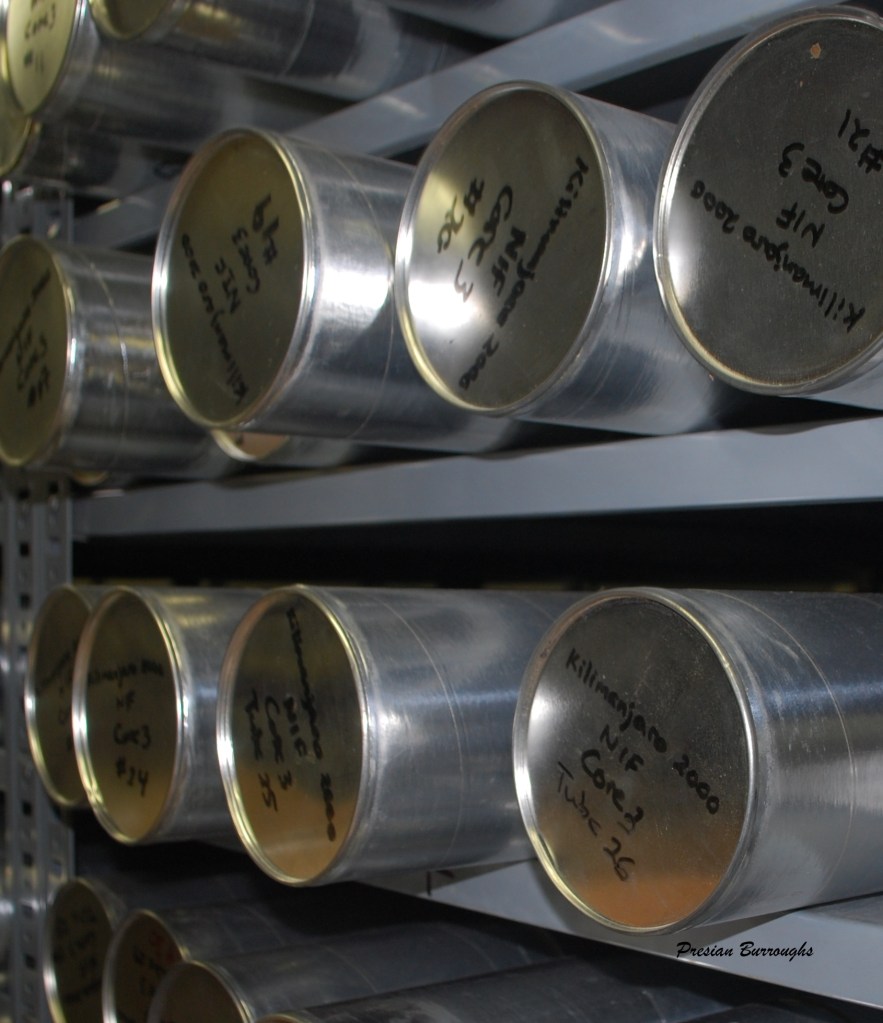
(Image of ice core samples at the Byrd Polar and Climate Research Center; photo by Presian Burroughs)

Not only does plowing cause CO2 to disperse into the air, it also decreases the soil’s fertility. Without sufficient carbon in the soil, microbes and macrobes (think, bacteria and worms) don’t have enough to eat and therefore die. Without the microbes and macrobes living there, minerals in the soil and nitrogen from the atmosphere cannot be converted into the nutrients plants need to absorb. Over the years, the process of plowing actually decreases the fertility of the soil and the earth’s ability to make new topsoil.
In addition to decreasing the amount of carbon in the soil, plowing speeds up the process of mineralization—the process by which nitrogen that once made up the proteins and amino acids of decaying plants and animals is broken down and converted into molecules plants can absorb.[4] Although this feeds plants in the short-term, after a few years, once the initial nitrogen is used up, the soil no longer has the ability to replenish the nitrogen unless nitrogen-fixing legumes are grown there.
Meanwhile, some of the soil’s nitrogen ends up as N2O and dissipates into the atmosphere. Consequently, from 1900 to 1950 when the native grasslands of the Great Plains were being plowed up and made into crop fields, the earth experienced “an increase in soil N2O emissions, translating into a substantial net release of [greenhouse gases]”.[5]

Plowing, then, not only diminishes soil fertility but also increases greenhouse gas concentrations.
(Image of water vapor and other gases rising from plowed field is from https://pixabay.com/photos/fog-mood-landscape-fog-bank-66270/.)
Decreasing soil fertility is a perennial problem farmers face, and scientists have been eager to find solutions. By the early 1900s soil scientists recognized the fundamental importance of nitrogen (in addition to potassium and phosphorus) for plant health and agricultural yield. Simultaneously, the bomb-making war efforts of WWI and WWII gave scientists new technologies that could take unreactive N2O from the atmosphere and convert it into ammonia through an energy-intensive reaction called the Haber-Bosch process. This process provided the means for chemists to create liquid chemical fertilizers that the now degraded soil in America’s heartland needed more than ever. But these fertilizers come at a high energy and ecological cost: making nitrogen fertilizers “consumes more energy than any other aspect of the agricultural process. It takes the energy from burning 2,200 pounds of coal to produce 5.5 pounds of usable nitrogen.”[6] In other words, in our fossil fuel based economy, manufacturing synthetic nitrogen fertilizers necessarily releases large amounts of CO2 into the atmosphere.
But that’s not all. Some of the nitrogen-based fertilizer sprayed on fields ends up as N2O in the atmosphere. Scientists estimate that about 1% of nitrogen fertilizer dissipates into the atmosphere.[7]

While this may not sound like much, the collective global effect of spraying fields with nitrogen fertilizer and spreading organic sources of nitrogen, such as manure, is staggering. Globally, the agricultural sector emits over 7,000,000 tons of N2O each year.[8]
(Image of increasing global N2O concentrations is from https://www.esrl.noaa.gov/gmd/hats/combined/N2O.html.)
A significant problem attending this situation is that nitrous oxide “is about three hundred times more powerful than carbon dioxide in creating climate warming.”[9] Nitrous oxide is a much more effective blanket than CO2.
Along with increasing the earth’s concentration of N2O, nitrogen fertilizers also harm aquatic ecosystems. Scientists figure about half of the nitrogen fertilizer farmers spray on crops isn’t even absorbed by the plants![10] Where does so much of the nitrogen-based chemical go? A bit of it floats into the atmosphere, as indicated above, but a lot of it ends up in our waterways, causing algal blooms and dead zones (I’ll discuss this in a future post). Overall, relying so heavily on chemical nitrogen fertilizers is simply not efficient or sustainable.
Although we might assume plowing is a benign and essential part of growing food, the facts of the matter indicate that plowing isn’t exactly healthy for our ecosystems. Plowing results in:
With all these drawbacks (in addition to another big one: soil erosion), it becomes clear why scientists and farmers work hard to find alternatives to conventional, industrial agricultural methods.
And when I consider these ecological factors in conversation with the Christian scriptures, I find theological reasons for supporting ecologically healthier forms of agriculture. For example, since Genesis 1 indicates that God created the world to be fertile and filled with a diversity of living beings (see my “The Creative Roles of Water & Land in Genesis 1:1-25”), I am led to question the ways in which industrial forms of agriculture undermine fertility and biodiversity. And since Genesis 1:29-30 explicitly teaches humans to share the plants of the earth with the rest of God’s creatures (see my “A Call to Share Plants & Soil: Genesis 1:29-30”), the destructive effects of plowing on the soil’s biome and global climate stability lead me to think long and hard about how we grow and eat our food.
Whether motivated by theological principles or not, people are beginning to recognize that plowing actually works at cross-purposes with our efforts to grow abundant and healthy food. Consequently, some farmers have turned to no-till and low-till methods of planting crops not only to avoid the problems outlined here but also soil erosion. These methods, however, often (but not always) rely on the use of herbicides and GMO crops. Since these are complex topics in and of themselves, we’ll consider them soon. Stay tuned!
[1] This transition from grassland to crops of course took place after the US unjustly and violently confiscated the lands and livelihoods of the Native Americans who once made their homes in the Great Plains. The foundation upon which American agriculture has been built is bloodstained and a shameful part of US history.
[2] Melannie D. Hartman et al., “Impact of Historical Land-Use Changes on Greenhouse Gas Exchange in the U.S. Great Plains, 1883-2003,” Ecological Applications 21, no. 4 (2011): 1117, http://dx.doi.org/10.2307/23022983.
[3] David R. Montgomery, Growing a Revolution: Bringing Our Soil Back to Life (New York: W. W. Norton & Company, 2017), 57.
[4] David Crohn, “Nitrogen Mineralization and Its Importance in Organic Waste Recycling,” accessed January 4, 2020. https://alfalfa.ucdavis.edu/+symposium/proceedings/2004/04-277.pdf.
[5] Hartman et al., 1117.
[6] Jason McKenney, “Artificial Fertility: The Environmental Costs of Industrial Fertilizers,” in The Fatal Harvest Reader: The Tragedy of Industrial Agriculture, ed. Andrew Kimbrell (Washington: Island Press, 2002), 127.
[7] Hartman et al., 1117.
[8] Debra A. Miller, Farming and the Food Supply, Confronting Global Warming (Detroit: Greenhaven Press, 2011), 80-81.
[9] Ibid.
[10] The Intergovernmental Panel on Climate Change calculates that “approximately 50% of the N applied to agricultural land [is] not taken up by the crop” [Gensuo Jia and Elena Shevliakova, “Chapter 2: Land-Climate Interactions,” in Climate Change and Land: An Ipcc Special Report on Climate Change, Desertification, Land Degradation, Sustainable Land Management, Food Security, and Greenhouse Gas Fluxes in Terrestrial Ecosystems (27/04/2019), 5.].
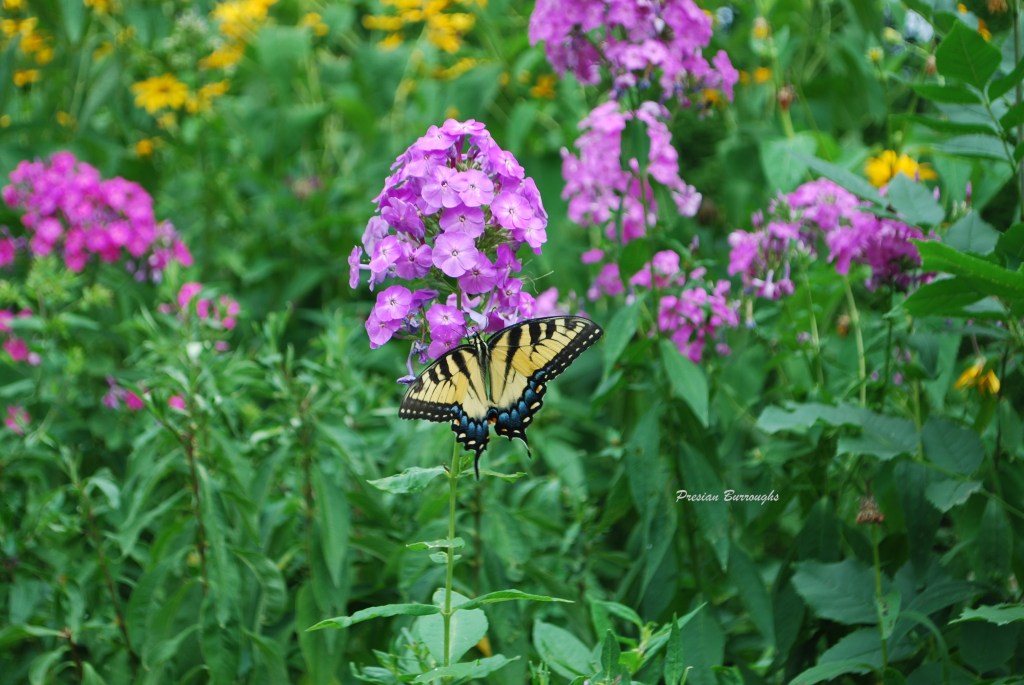
Genesis 1 presents us with a portrait of creation buzzing with life.

There’s a diversity of plants, all with the ability to reproduce themselves and sustain the lives of others. Aquatic, avian, and terrestrial animals fill the waters, skies, and lands, finding plentiful nourishment from plants. And human beings carry the blessing and image of God as they too enjoy the earth’s rich botanical bounty.
At this point in the creation story, God has not yet given humans permission to kill animals and eat their flesh. That permission won’t come until after the flood and the establishment of God’s covenant with the earth in Gen 9:3, 13. But there’s more than enough food to go around, and the land and plants have the creative capacity to continue sprouting plants and bearing seed.
Simply recognizing the foundational role plants and soils play in human and animal welfare, according to Genesis 1, should be enough to inspire people to devote significant efforts to cultivating gardens, establishing green spaces, preserving vast stretches of forests, and sustaining seed stocks. Yet, we know that’s not the case when, “between 1990 and 2016,” human societies cut down “502,000 square miles (1.3 million square kilometers) of forest.”[1]
But beyond the general notion that plants are foundational, Genesis 1 gives us an even more explicit reason to pay attention to how we treat plants and soils. In verses 29-30, God explains to the humans,
“See, I have given you every plant yielding seed that is upon the face of all the earth, and every tree with seed in its fruit; you shall have them for food. And to every beast of the earth, and to every bird of the air, and to everything that creeps on the earth, everything that has the breath of life, I have given every green plant for food.” And it was so (Gen 1:29-30).

We discover from these verses that God expects humans to share the earth’s provision of plants not only with each other but with all animals. For, after God blesses the human male and female and orders them to have “mastery among”[2] the other creatures, God designates their food source as plants with seed and fruit from trees. Then, demonstrating not only care for humans but also all animate life, God gives “every green plant” as food to all creatures that have the breath of life. It’s as if animals have been given a divine grant to green plants and to the healthy soils that produce them.
However, because we humans tear up so many plants and pave over so much fertile soil, we put significant amounts of pressure on animal food sources (not to mention the sources of food for indigenous people). By disrupting and removing native forests, replacing fruit and seed-bearing native plants with manicured lawns, and spraying large expanses of land with herbicides (as in most forms of agriculture today),[3] we remove the plants on which God’s creeping, crawling, prowling, flying creatures depend.
Now, of course, we humans have to eat too. But I’m willing to bet that many of us could reduce and change our consumption patterns so that fewer rainforests, for example, are cut down (often to make way for beef cattle, soybeans, or palm plants). We could prod ourselves, our relatives, our friends, and our colleagues to consider the common good—of humanity and the rest of God’s creation—when we purchase something and otherwise make decisions about how we use land. Genesis 1 teaches it’s not just about us and the gratification of our own desires. God expects us to share this beautiful and bountiful planet with all. How might you support the ecological common good in 2020? I’d love to hear your thoughts!
For information about rainforest protection and sustainable agriculture, see:
For interesting discussions of how some human societies have positively supported biodiversity and ecosystem stability, see:
What organizations and resources do you recommend? Leave suggestions in the comment box and don’t forget to subscribe!
Get new content delivered directly to your inbox.
[1] Christina Nunez, “Climate 101: Deforestation,” National Geographic (February 7 2019), https://www.nationalgeographic.com/environment/global-warming/deforestation/.
[2] Ellen Davis suggests this translation rather than “dominion over” [Ellen F. Davis, Scripture, Culture, and Agriculture : An Agrarian Reading of the Bible (New York: Cambridge University Press, 2009), 55.].
[3] I’ll discuss the negative ecosystem effects of herbicides in detail in a future “Creation” post.

On Christmas morning, the calcium carbonate bones of the earth cradled Jesus’ newborn body.

